
A husband, a father of 7, a runner training for 2 marathons this year as a Hammer Nutrition sponsored athlete,a guitar player,a digital artist and a computer programmer by day. I got this.
Friday, August 07, 2009
Riff of the Week
I came across a great resource for all you guitarists out there. It's called Riff of the Week. It is a weekly vidcast by a guy named Dave Weiner. Dave is the 'other' guitarist for Steve Vai's band. Dave takes a few minutes each week to show a cool riff, technique or tonal idea. He also has put up a section on his website with a bunch of background tracks for practicing improvisation. They range in style from Jazz to Metal, in several different keys and modal tonalities. Like I said, a great resource. So, check it out at http://www.riffoftheweek.com


Wednesday, July 29, 2009
Tech Tools for Musicians - Lilypond
Musical scoring is a much needed evil. From trying to put together a lead sheet to a full up score, if you want to communicate with musicians, it is the best way. But my handwriting is terrible! You do not want to see a handwritten piece of music from me. So that is where software comes in. The full version of Finale (one of the premier notation software tools) is $450. Sometimes I just want to create a few lines of music for a student for free. But I want it to look good. Also the option of having TAB isn't bad either. It's this need that led me to Lilypond.
Lilypond at it's simplest is a text based generator for quality music scores. The upside is that it is open source. The downside is how you make a score. It is fully text based. But fear not. If you are a quick study, you will be making nice looking scores in no time.
For instance, say you wanted to create a simple line of music like this:
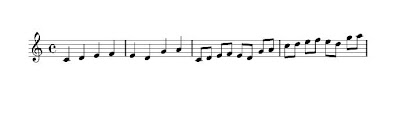
\version "2.13.3"
\score {
 \relative c' { c4 d e f  e d g a  c,8 d e f e d g a  c d e f e d g a }
}
Now before you freak out that this is impossible, lets break it down. The first line is simply the version of lilypond you are using. The next line is the begining of a new score. Then a line of notes. The \relative c' means that the notes are relative to middle C. Then as you write in notes it goes to the nearest pitched note. If you want to force it up or down an octave you use an apostrophe or a comma and you add a number behind notes to indicate their duration. the same duration is used on subsequent notes until a new duration is given.Once you have Lilypond installed and you give this file a name like music.ly, all you have to do is double click the file and Lilypond will generate a PDF of your music. With a few extra commands, you can have it also generate svg, png or postscript.
You can see some examples of very complex scores at the Lilypond site.
There are many types of extras you can add to the score like:
\header {
title = "Practice Etude #1"
composer = "Johnny Matthews (1976-)"
}
\version "2.13.3"
melody =  { c4 d e f  e d g a  c,8 d e f e d g a  c d e f e d g a }
\score {
<<  \new Staff \relative c {
\clef "treble_8"
\melody
}
\new TabStaff \relative c { \set TabStaff.minimumFret = #0
\melody
}
>>
}
\score {
<<
\new Staff \relative c { \clef "treble_8"
\melody
}
\new TabStaff \relative c {\set TabStaff.minimumFret = #5
\melody
}
>>
}
and here is the result:

As you can see I've reused the melody 4 times, 2 times in music and 2 times in TAB. I altered the second line of TAB to have a minimum fret of 5. Lilypond does the fingering for me. You can override the fingering if you really want to. The possibilities are really quite extreme. There are tons of features and settings. From articulations, chords names, chord charts, lyrics, altered note heads (for percussion notation), we have barely scratched the surface here.
Stay tuned for some more in depth tutorials on using Lilypond.
Friday, July 24, 2009
Pizza Night
Recently a co-worker of mine wrote about making pizza, and I was inspired to do the same.


If there is one food I love in most of it's forms, it's pizza. My family loves it as well. With 7 of us (including grandpa) we can go through a couple of large pizzas without too much trouble and at $10-$15 a pizza, ordering in is expensive. I enjoy cooking a good meal and so about 6 months ago I started looking up pizza on the internet. I found a dough recipe that sounded good and the same with the sauce. I have over time altered the recipe a bit and have come up with something that my family loves and is fun to make. Also, depending on the toppings, is very inexpensive.
The Dough
2 Cups Warm Water
1 Tablespoon Sugar
1 Tablespoon Salt
1 Tablespoon Olive Oil
4 1/2 to 5 Cups White Flour
(substitute 2 of the cups with whole wheat flour for a heartier dough)
1/2 Tsp dry yeast
Mix the water, sugar, salt, olive oil and 2 cups of flour till well mixed. Add 2 more cups flour about 1/2 cups at a time till it makes a sticky ball. Start kneading the dough adding a little flour at a time to keep the ball from sticking. Add the yeast and knead for about 10 minutes. Divide into 2 balls, and set them in a covered bowl for 1 to 2 hours.
The Sauce
2 Cans Tomato Sauce
1 Tablespoon Salt
3 Tablespoons Sugar
1 Tsp Olive Oil
Garlic Powder, Basil, Oregano, other Italian spices to taste.
Combine and bring to a boil for about 5 minutes. Cover and simmer on med-low for about 30-45 minutes.

Assembly
Preheat your oven and baking stone to 475.

Press dough ball into circle and use a rolling pin to extend it out to size (you can throw it if you so choose). Use corn meal to dust dough and place on stone. Add 1/2 the sauce, cheese and any other toppings you like. Cook for around 10-12 minutes on the middle rack. Watch closely so that you do not burn your cheese.

By the way if you are going to do this, I would recommend buying your cheese in bulk at Sam's Club. You can get a 20 cup bag of shredded mozzarella for about $8.50. That's really cheap compared to the little 2 cup bags of cheese you get at the grocery store for $3.00 or more each. That really brings the cost down. All in all you can make a couple large pizzas for only a few dollars each.
Monday, January 19, 2009
Learning Modes - Some formulas
Once you start getting the idea of modes, one of the easiest ways to deal with them is knowing how they are spelled relative to their ionian version. We can Use the key of C as a great example.
C Ionian     C  D  E  F  G  A  B    C Major
C Dorian     C  D  Eb F  G  A  Bb   Bb Major
C Phrygian   C  Db Eb F  G  Ab Bb   Ab Major
C Lydian     C  D  E  F# G  A  B    G Major
C Mixolydian C  D  E  F  G  A  Bb   F Major
C Aeolian    C  D  Eb F  G  Ab Bb   Eb Major
C Locrian    C  Db Eb F  Gb Ab Bb   Db Major

Since C Ionian has no altered notes, we can use that as a very nice baseline

Ionian      - No Changes
Dorian      - b3 b7
Phrygian    - b2, b3, b6, b7
Lydian      - #4
Mixolydian  - b7
Aeolian     - b3, b6, b7
Locrian     - b2, b3, b5, b6, b7

So if we simply apply this formula to a major/ionian scale, we transform it into that mode.
Sunday, January 18, 2009
Learning Modes - Extending the Chords
Now that we have a list of the triads that are diatonic to the modes of our key, we can extend them to include the diatonic 7th chords of the modes. We now have an even wider canvas to paint with. You may just thing that this is just slapping 7ths on each chord type. For Diminished and Minor, it pretty much is. But for the major 7ths you have to be careful. Because 2 will be major 7th and 1 will be dominant 7th.
I          Ionian,Lydian,Mixolydian
Imaj7      Ionian,Lydian
I7         Mixolydian
i          Dorian,Phrygian,Aeolian
imin7      Dorian,Phrygian,Aeolian
i°         Locrian
i°7        Locrian
II         Lydian
II7        Lydian
ii         Ionian,Dorian,Mixolydian
iimin7     Ionian,Dorian,Mixolydian
ii°        Aeolian ii°7    Aeolian
bII        Phrygian,Locrian
bIImaj7    Phrygian,Locrian
iii        Ionian,Lydian
iiimin7    Ionian,Lydian
iii°       Mixolydian
iii°7      Mixolydian
bIII       Dorian,Aeolian,Phrygian
bIIImaj7   Dorian,Aeolian
bIII7      Phrygian
biii       Locrian
biiimin7   Locrian
IV         Ionian,Dorian,Mixolydian
IVmaj7     Ionian,Mixolydian
IV7        Dorian
iv         Phrygian,Aeolian,Locrian
ivmin7     Phrygian,Aeolian,Locrian
#iv°       Lydian
#iv°7      Lydian
V          Ionian,Lydian
Vmaj7      Lydian
V7         Ionian
v          Dorian,Mixolydian,Aeolian
vmin7      Dorian,Mixolydian,Aeolian
v°         Phrygian
v°7        Phrygian
bV         Locrian
bVmaj7     Locrian
vi         Ionian,Lydian,Mixolydian
vi min7    Ionian,Lydian,Mixolydian
vi°        Dorian
vi°7       Dorian
bVI        Phrygian,Aeolian,Locrian
bVImaj7    Phrygian,Aeolian
bVI7       Locrian
vii°       Ionian
vii°7      Ionian
vii        Lydian
vii min7   Lydian
bVII       Dorian,Mixolydian,Aeolian
bVII maj7  Dorian,Mixolydian
bVII7      Aeolian
bvii       Phrygian,Locrian
bvii min7  Phrygian,Locrian
Tuesday, January 13, 2009
Learning Modes - Another Step
In my last post, we looked at a very simple chord progression with a couple of chords. Most likely you will be playing music that is much more complicated. So what happens when a Cm shows up in your song in G major? There is a note in that chord that is not in your key! Well there are a couple things you can do here.
Now if we use this chart we can easily get our list of available modes for many chords that may be in our tune. If we run across an Ab major chord in our key of G tune (which would be a bII), we see that G phrygian (Eb Major) or G Locrian (Ab Major) might work well. Which would make sense since playing Ab major over an Ab Major chord would make sense.
- Do not play an E during this chord
- Switch to C Minor
- Find some other mode that works
Well option 1 is simple enough, but we want to spice things up a little. Option 2 and 3 actually go together. If we look closely at C minor, we find that it is 3 flats. Bb,Eb,Ab. Now by looking at the key signature, we see that the relative Major to C minor is Eb Major. If we look at the relative Majors to modes of G, we have G-F-Eb-D-C-Bb-Ab. So Eb Major == 3rd mode of G, which is G Phrygian. To see what other modes of G we could play over this Cm chord, we simply need to see which of the modes of G contain a Cm chord. Well since Cm is C-Eb-G we can see that Eb Major, Bb Major and Ab Major have Eb's in them (as well as C's and G's). So our options for playing over a Cm in G are
- G Phrygian (Eb Major)
- G Aeolian/minor (Bb Major)
- G Locrian (Ab Major)
Get ready for a little bit of information overload. If we take the notes of the modes of G
G Ionian     G A  B  C  D  E  F#  G Major
G Dorian     G A  Bb C  D  E  F   F Major
G Phrygian   G Ab Bb C  D  Eb F   Eb Major
G Lydian     G A  B  C# D  E  F#  D Major
G Mixolydian G A  B  C  D  E  F   C Major
G Aeolian    G A  Bb C  D  Eb F   Bb Major
G Locrian    G Ab Bb C  Db Eb F   Ab Major
and then figure out what all the triads are
Ionian         G  Am Bm  C   D  Em F#°
Dorian         Gm Am Bb  C   Dm E° F
Phrygian       Gm Ab Bb  Cm  D° Eb Fm
Lydian         G  A  Bm  C#° D  Em F#m
Mixolydian     G  Am B°  C   Dm Em F
Aeolian        Gm A° Bb  Cm  Dm Eb F
Locrian        G° Ab Bbm Cm  Db Eb Fm
we can make a list of the modes that contain each chord
G   Ionian,Lydian,Mixolydian
Gm  Dorian,Phrygian,Aeolian
G°  Locrian
A   Lydian
Am  Ionian,Dorian,Mixolydian
Ab  Phrygian,Locrian
A°  Aeolian
Bm  Ionian,Lydian
B°  Mixolydian
Bb  Dorian,Aeolian,Phrygian
Bbm Locrian
C   Ionian,Dorian,Mixolydian
Cm  Phrygian,Aeolian,Locrian
C#° Lydian
D   Ionian,Lydian
Dm  Dorian,Mixolydian,Aeolian
D°  Phrygian
Db  Locrian
Em  Ionian,Lydian,Mixolydian
E°  Dorian
Eb  Phrygian,Aeolian,Locrian
F#° Ionian
F#m Lydian
F   Dorian,Mixolydian,Aeolian
Fm  Phrygian,Locrian
Then we can generalize them into a more portable method using chord numbers
I     Ionian,Lydian,Mixolydian
i     Dorian,Phrygian,Aeolian
i°    Locrian
II    Lydian
ii    Ionian,Dorian,Mixolydian
ii°   Aeolian
bII   Phrygian,Locrian
iii   Ionian,Lydian
iii°  Mixolydian
bIII  Dorian,Aeolian,Phrygian
biii  Locrian
IV    Ionian,Dorian,Mixolydian
iv    Phrygian,Aeolian,Locrian
#iv°  Lydian
V     Ionian,Lydian
v     Dorian,Mixolydian,Aeolian
v°    Phrygian
bV    Locrian
vi    Ionian,Lydian,Mixolydian
vi°   Dorian
bVI   Phrygian,Aeolian,Locrian
vii°  Ionian
vii   Lydian
bVII  Dorian,Mixolydian,Aeolian
bvii  Phrygian,Locrian
Now if we use this chart we can easily get our list of available modes for many chords that may be in our tune. If we run across an Ab major chord in our key of G tune (which would be a bII), we see that G phrygian (Eb Major) or G Locrian (Ab Major) might work well. Which would make sense since playing Ab major over an Ab Major chord would make sense.
Does this mumbo jumbo make sense? Have I made a chordal miscalculation? Sound off in the comments.
Friday, January 09, 2009
Learning Modes - Putting Something Together
Now that we can find a major scale that is equivalent to a mode we need to be able to know how to choose which modes to play. Here is one method that can yield some good results. For starters lets look at a very simple chord progression in the key of G:
|: G | C | G | D7 :|
We need to determine what modes work with which chords. To do this of course, we need to be able to spell our chords. First take G Major which is made up of G-B-D. Lets find which modes retain these 3 notes.
G Ionian (G,A,B,C,D,E,F#,G) - This works
G Dorian (G,A,Bb,C,D,E,F,G) - Nope it has a Bb
G Phrygian (G,Ab,Bb,C,D,Eb,F,G) - Nope Bb and Eb
G Lydian (G,A,B,C#,D,E,F#,G) - Yes
G Mixolydian (G,A,B,C,D,E,F,G) - Yes
G Aeolian (G,A,Bb,C,D,Eb,F,G) - No
G Locrian (G,Ab,Bb,C,Db,Eb,F,G) - No
So from this we see that G Ionian (major),G Lydian and G Mixolydian will work for a G Major chord.
Next we look at C Major which is made of C-E-G
G Ionian (G,A,B,C,D,E,F#,G) - Yes
G Dorian (G,A,Bb,C,D,E,F,G) - Yes
G Phrygian (G,Ab,Bb,C,D,Eb,F,G) - No
G Lydian (G,A,B,C#,D,E,F#,G) - No
G Mixolydian (G,A,B,C,D,E,F,G) - Yes
G Aeolian (G,A,Bb,C,D,Eb,F,G) - No
G Locrian (G,Ab,Bb,C,Db,Eb,F,G) - No
C major works with G Major, G Dorian and G Mixolydian
and Finally D7 which is D-F#-A-C
G Ionian (G,A,B,C,D,E,F#,G) - Yes
G Dorian (G,A,Bb,C,D,E,F,G) - No
G Phrygian (G,Ab,Bb,C,D,Eb,F,G) - No
G Lydian (G,A,B,C#,D,E,F#,G) - No
G Mixolydian (G,A,B,C,D,E,F,G) - No
G Aeolian (G,A,Bb,C,D,Eb,F,G) - No
G Locrian (G,Ab,Bb,C,Db,Eb,F,G) - No
So we will stick with G Major for the D7
When we map this out
So we have several options here we can play major all the way or use any combination we choose. When we use G Lydian we have a #4 note added and when we play G Mixolydian we have a b7 note.
We could of course look at the scales under the C chord in terms of C if you really wanted to, You would find that G Dorian = C Mixolydian,G Major = C Lydian and we already saw that G Mixolydian = C Major, but these are all enharmonic and so dealing with them all as modes of G can make it easier for some.
So here is an mp3 (inside the zip file) of these 3 chords that you can put on repeat on your computer and try jamming over these chords using these modes. I threw this together at 1:30am, so it probably won't sound very good. Anyway check it out and good luck!
|: G | C | G | D7 :|
We need to determine what modes work with which chords. To do this of course, we need to be able to spell our chords. First take G Major which is made up of G-B-D. Lets find which modes retain these 3 notes.
G Ionian (G,A,B,C,D,E,F#,G) - This works
G Dorian (G,A,Bb,C,D,E,F,G) - Nope it has a Bb
G Phrygian (G,Ab,Bb,C,D,Eb,F,G) - Nope Bb and Eb
G Lydian (G,A,B,C#,D,E,F#,G) - Yes
G Mixolydian (G,A,B,C,D,E,F,G) - Yes
G Aeolian (G,A,Bb,C,D,Eb,F,G) - No
G Locrian (G,Ab,Bb,C,Db,Eb,F,G) - No
So from this we see that G Ionian (major),G Lydian and G Mixolydian will work for a G Major chord.
Next we look at C Major which is made of C-E-G
G Ionian (G,A,B,C,D,E,F#,G) - Yes
G Dorian (G,A,Bb,C,D,E,F,G) - Yes
G Phrygian (G,Ab,Bb,C,D,Eb,F,G) - No
G Lydian (G,A,B,C#,D,E,F#,G) - No
G Mixolydian (G,A,B,C,D,E,F,G) - Yes
G Aeolian (G,A,Bb,C,D,Eb,F,G) - No
G Locrian (G,Ab,Bb,C,Db,Eb,F,G) - No
C major works with G Major, G Dorian and G Mixolydian
and Finally D7 which is D-F#-A-C
G Ionian (G,A,B,C,D,E,F#,G) - Yes
G Dorian (G,A,Bb,C,D,E,F,G) - No
G Phrygian (G,Ab,Bb,C,D,Eb,F,G) - No
G Lydian (G,A,B,C#,D,E,F#,G) - No
G Mixolydian (G,A,B,C,D,E,F,G) - No
G Aeolian (G,A,Bb,C,D,Eb,F,G) - No
G Locrian (G,Ab,Bb,C,Db,Eb,F,G) - No
So we will stick with G Major for the D7
When we map this out
| |:G | C | G | D7 :| |
| G Major G Lydian (D Major) G Mixolydian (C Major) | G Major G Dorian (F Major) G Mixolydian (C Major) | G Major G Lydian (D Major) G Mixolydian (C Major) | G Major |
So we have several options here we can play major all the way or use any combination we choose. When we use G Lydian we have a #4 note added and when we play G Mixolydian we have a b7 note.
We could of course look at the scales under the C chord in terms of C if you really wanted to, You would find that G Dorian = C Mixolydian,G Major = C Lydian and we already saw that G Mixolydian = C Major, but these are all enharmonic and so dealing with them all as modes of G can make it easier for some.
So here is an mp3 (inside the zip file) of these 3 chords that you can put on repeat on your computer and try jamming over these chords using these modes. I threw this together at 1:30am, so it probably won't sound very good. Anyway check it out and good luck!
Monday, January 05, 2009
Learning Modes - Finding the Relative Major
In my last article on modes we discussed how you can find a given mode by playing a major scale at a given interval from the original note.
First take a look at this slightly confusing table.
If you look at this chart you will get a quick reference to where you will find the scale you are needing.
Lets take a example:
Say we are playing a G major chord, we have 3 mode options that might sound good with it. Ionian, Lydian and Mixolydian since they are the 3 "major" tonality modes (that is the 3rd is a major 3rd in the mode). So how do we get to G Ionian, G Lydian and G Mixolydian? I always have an easier time going up an interval rather than down so in the chart above, I have converted the intervals down from the WWHWWWH pattern we talked about in the previous article to ascending intervals.
So now we can grab a mode from a given chord.
First take a look at this slightly confusing table.
| Mode | Tonality | Steps Down | 1/2 Steps Down | Interval Down | 1/2 Steps Up | Interval Up |
| Ionian (Major) | Major | 0/12 | Unison/Octave | 12/0 | Unison/Octave | |
| Dorian | Minor | W | 2 | Major 2nd | 10 | Minor 7th |
| Phrygian | Minor | WW | 4 | Major 3rd | 8 | Minor 6th |
| Lydian | Major | WWH | 5 | Perfect 4th | 7 | Perfect 5th |
| Mixolydian | Major / Dom | WWHW | 7 | Perfect 5th | 5 | Perfect 4th |
| Aeolian (Minor) | Minor | WWHWW | 9 | Major 6th | 3 | Minor 3rd |
| Locrian | Diminished | WWHWWW | 11 | Major 7th | 1 | Minor 2nd |
| (Ionian) | Major | WWHWWWH | 12/0 | Unison/Octave | 0/12 | Unison/Octave |
If you look at this chart you will get a quick reference to where you will find the scale you are needing.
Lets take a example:
Say we are playing a G major chord, we have 3 mode options that might sound good with it. Ionian, Lydian and Mixolydian since they are the 3 "major" tonality modes (that is the 3rd is a major 3rd in the mode). So how do we get to G Ionian, G Lydian and G Mixolydian? I always have an easier time going up an interval rather than down so in the chart above, I have converted the intervals down from the WWHWWWH pattern we talked about in the previous article to ascending intervals.
- G Ionian = G Major, since Ionian = Major
- G Lydian is the major scale starting a perfect 5th above the scale in question. So a perfect 5th above G is D. So G Lydian = D Major
- G Mixolydian is the major scale starting a Perfect 4th above the note in question which is C, so G Mixolydian = C Major.
- A minor 7th above F is Eb. Eb Major is F dorian
- A minor 6th above F is Db.Db Major is F Phrygian
- A minor 3rd above F is Ab. Ab Major is F Aeolian
So now we can grab a mode from a given chord.
Saturday, January 03, 2009
Learning Modes - The Relative Major Way
Ok so I did not invent this, but I did come up with it out of my own studies (as my college theory prof told me...the hard way). But I like many others learned early on 3 things about modes
- The seven modes were just "starting" on the 7 notes of the scale. So If you were playing a C major scale and went from D to D it was D dorian, E to E was E Phrygian, etc.
- Modes could sound really cool.
- Modes were hard to apply in real life.
So I have had an idea to make a play-along CD/MP3 set for my guitar students where they would get simple to progressively more intricate chord progressions to try to improvise over and give them advice on trying different modes with them. The problem was trying to find a quick way to determine what mode went with what scale. I did not want C major, D Dorian, E Phrygian, etc. I wanted C Major, C Dorian, C Phrygian, etc. So what was a quick way to find this. Well, I started by writing them out.
| C Major | C | D | E | F | G | A | B |
| C Dorian | C | D | Eb | F | G | A | Bb |
| C Phrygian | C | Db | Eb | F | G | Ab | Bb |
| C Lydian | C | D | E | F# | G | A | B |
| C Mixolydian | C | D | E | F | G | A | Bb |
| C Aeolian | C | D | Eb | F | G | Ab | Bb |
| C Locrian | C | Db | Eb | F | Gb | Ab | Bb |
Then of course since modes were just scales starting on different notes of a certain key then each of these should be enharmonic to a major scale. So I wrote those out
| C Major (Ionian) | C Major |
| C Dorian | Bb Major |
| C Phrygian | Ab Major |
| C Lydian | G Major |
| C Mixolydian | F Major |
| C Aeolian | Eb Major |
| C Locrian | Db Major |
Well that was all helpful and all but I wanted a pattern to follow. How could this list of keys be related? Well Somehow I noticed a pattern
Bb is a whole step below C, Ab is a whole step below Bb and G is a halfstep below Ab. Whole, Whole Half. Well if you are familiar with how a major scale is built, it Goes
Whole, Whole, Half, Whole, Whole, Whole, Half
in the forward direction (C,D,E,F,G,A,B,C)
When you look at the relative major keys that make up the modes of a given key. They use the same pattern going backwards.
C,Bb,Ab,G,F,Eb,Db,C
So if you are in C and want to play C Lydian, since lydian is the 4th mode. You can go down Whole (to dorian), Whole (to Phrygian) , Half (to Lydian) which is the Key of G Major. So if you play G Major over a C major that is C Lydian. Which works since Lydian is the same as a raised 4th. F is the 4th note of the C scale and in the key of G it is sharped.
Now should you ignore how to spell your modes without this method? Certainly not! but this can give you a "cheat sheet" way of getting into a given mode.
Next time we will talk about applying this to the guitar.
Wednesday, December 31, 2008
Guitar Gear for Beginners - Part 8 - Pitch Effects
There are a couple of effects that will effect the pitch of your instrument.
The octave pedal does what it's name says, it shifts the pitch of your instrument by octaves. Some have options as to what octave you want to add. One octave up, one down, 2 down, etc. Then levels of how much original signal and shifted signal to have. The Boss OC-3 Super Octave is an example of a octave pedal.
Pitch Shifter
The pitch shifter is a much more complex unit. There are some pitch shifters that do the same thing as an octave pedal except with other pitches, like a 5th or a 4th. The new generation of pitch shifters let you tell the pedal what key you are playing in and then it can tell if you are doing say 3rd harmonies, if it should be a minor 3rd or a major third, so that your harmony notes are in the right key. The Boss PS-5 Super Shifter and the DigiTech HarmonyMan are examples of this type of pedal.
What do I Use?
Right now I don't have either of these types of pedals on my pedalboard. They are just not what I need at the moment.
Do you use an octave or pitch shifting pedal that I have not mentioned? Let us know in the comments.
Tuesday, December 30, 2008
Guitar Gear for Beginners - Part 7 - Time Effects
Time based effects are those that elongate, or repeat our sounds. Here are 3 types of effects that fall into this category.
Delay is an echo effect. Depending on the unit we are using, we will set a delay time (how fast does it echo) and a regeneration factor (how quickly does it get quieter with each echo) and a count of how many echos we want. Some examples of delay effects are the Boss DD-3 which is a pretty simple delay pedal, or the Boss DD-7 which is the same pedal as the DD-3 but has a few more delay styles as well as the option for an external 'tap tempo' which will allow you to set your delay speed by clicking a separate pedal. One Delay pedal that I have not had the opportunity to play, but have heard great things about is the Line 6 DL4. This unit has 3 programmable presets (so you don't have to tweak settings while you are playing) and a dedicated tap tempo button.
Reverb
Reverb is an effect that lets a sound trail off as if it were in a room where the echo time was very short. Or as Wikipedia puts it "Reverbration, or "reverb", is the persistence of sound in a particular space after the original sound is removed. " A lot of amps have an reverb unit built in. If you have ever moved an amp and gotten a loud sound come out of it that sounded like giant springs, that would be the spring reverb unit in the amp. There are some pedal based reverb units as well if you want more control of your reverb sounds. The Boss RV-5 is one example or the Line 6 Verbzilla which has 11 different types of reverb built it.
Looping
Loopers are a similar idea to delay except that they let you store more than 1 "sample" and then layer them on top of one another. One major difference between a delay pedal and a looper is that most delay pedals will only let you take a sample of up to maybe 2 seconds, where a looper will provide much longer samples. Here is an example of a guy playing with a looper. Boss make a looper in simple pedal, the Boss RC-2 Loop Station as well as a more complex and larger unit, the Boss RC-20XL Loop Station, Line 6 and Digitech also have offerings in this area as well.
What do I use?
Personally, I use the built in reverb in my Crate V33-212 amp and a Boss DD-6 which from what I can tell has been discontinued in favor of the DD-7. One of these days I need to get my hands on a looper, but it is not really high on my priorities list right now.
So what time based effects do you use? Sound off in the comments section.
Monday, December 29, 2008
Guitar Gear for Beginners - Part 6 - Modulation Effects
Phaser, Flanger, Chorus are several of the more popular modulation effects. The difference between them can be a little difficult to explain, but I'll give it a go.
Chorus
Chorus works by playing a copy of the sound coming in again just slightly later than the original (like 100ms later) and lightly altering it's pitch. This makes it sound like 2 or more instruments are playing the same thing at the same time, a chorus of instruments if you will. The Boss CH-1 is a nice simple chorus pedal.
Flanger
A flanger works very much like a chorus, except that the delay is much shorter and a portion of the delayed signal is fed back into the delay. This creates a swooshing sound. The term flange actually comes from when in the reel to reel studio days they would have 2 synced up tape machines and press their finger on the 'flange' of the tape reel, slowing it down a little and the combined sound would give the same effect. This MXR Flanger pedal seems to be pretty popular although I have not played it myself.
Phaser
A phaser although it has a similar sound to a flanger works in a different way. The sound rather than being delayed has it's phase shifted and added back to itself based on a filter. This phase shifting creates the phaser sound
What Do I Use?
Right now the only one of these 3 pedals that I use is a Boss CH-1 Chorus pedal. I personally have never been a huge fan of flange/phase effects so I have not spent any money on them. But that is just a personal preference as there is certainly nothing 'wrong' with those effects. They can be used very nicely, but please, use in moderation :)
Do you have a modulation effect that you love? If so sound off below and let us all know what you have discovered!
Sunday, December 28, 2008
Guitar Gear for Beginners - Part 5 - Volume Effects
Compressor
The compressor is a tough effect to explain if you have not worked it it before. The basic idea is this: As you play louder, it turns you down. So that way you can turn up the quiet stuff without blowing out the doors with the loud stuff. Depending on how fast your effect is set, it can create a very "punchy" tone due to the compressor kicking in. The MXR Dyna Comp is a popular compressor as well as the Boss CS-3.
Tremolo
Tremolo is a volume effect were the volume is turned up and down within a set range at a set tempo. This effect is very popular in 'surf music' The Boss TR-2 or the Voodoo Lab Tremolo are example pedals. Generally the speed and depth are set with knobs on the unit. Some pedals have a "tap" feature, allowing the speed to be setting by tapping your foot on the unit.
Volume Pedal
A volume pedal is a rocking pedal that takes it's incoming signal and turns it down based on how far forward or back it is set. The Visual Visual Volume Pedal or the Boss FV-500H are good examples.
What do I Use?
I have an old version of the Boss volume pedal on my pedal board. It is over 15 years old and still works great (another reason I love boss). I use the MXR Dyna Comp pedal and am currently in the market for a good tremolo pedal.
If you have favorite pedal in these categories that I have not mentioned, let everyone know by commenting below!
Saturday, December 27, 2008
Guitar Gear for Beginners - Part 4 - Filter Effects
Filter effects are basically effects that take your sounds and either cut or boost certain frequecies.
An EQ pedal does the exact same thing the EQ on a stereo does. It lets you pick a frequency and cut or boost it. Having it in a pedal means you can turn it on or off at a whim and it is within your reach if you need to make a change. The MXR M-108 or the Boss GE-7 are examples of EQ pedals.
Wah
Wah is basically an eq pedal with a small group of frequencies boosted and the others cut, then when you rock your foot on the pedal, it select what that range of frequencies is set at. A talented wah player can get very creative tones from a pedal. There is also a series of pedals that simulate a wah effect based on how hard you play, these are called auto-wah or envelope filters. The Dunlop Crybaby is probably the most classic wah pedal.
What Do I use?
Well right now, I do not have an EQ or Wah pedal in my rig.
Got a favorite wah pedal? How about a great EQ pedal you use? Post a comment below!
Friday, December 26, 2008
Guitar Gear for Beginners - Part 3 - Distortion Effects
It seems like at the beginning of every gear based email that I write, I start with a disclaimer that xyz is a little complicated, and effects are no different. One of the things that makes effects such a wide subject is that there are so many different types that do drastically different things.
There are really 2 ways to acquire effects (that can be combined), first is the "Stomp Box", the classic effect pedal and second is multi-effects, which can either be pedal based or rack based. We will first take a look at the various types of effects. With each effect, I'll mention a pedal version. If you are interested rather in multi-effects we will get to that later on.
Distortion Effects
Gain effects are any in a wide variety that effect the overall strength of the signal. The main type of effect in this group is distortion. When you increase the gain past the amount the circuit is designed to handle, it 'clips' this clipping is what causes the distorted sound we are so used to. When you are just on the edge of distortion, it is called overdrive which is very light clipping, adds a bit of 'dirt' to the sound. Usually only on louder notes or chords. Distortion is when your signal is always clipping, the level of distortion is based on how hard it is being pushed. There are dozens of pedals that can give you distortion. One of the classics is the Boss DS-1 this pedal will give you a reasonable range of distortions, although having a DS-1 modded by Keeley Electronics this upgrade takes your $40 Boss pedal and really adds some fullness to it. See this Youtube video for a comparison. By the end of this series you will probably think I am a shill for Boss, but I have always liked their stuff and I have a bunch of it myself, it is built pretty tough. That being said, The Boss BD-2 is another great pedal. This overdrive pedal when set right can give your guitar that little bit of dirt that really makes it stand out. The Ibanez TS808 is another classic distortion pedal. If you are in to much heavier tones, you also might want to check out the Boss ML-2 Metal Core or the Boss MT-2 Metal Zone which give "high gain" style distortion found in the various forms of metal music.
Distortion Effects
Gain effects are any in a wide variety that effect the overall strength of the signal. The main type of effect in this group is distortion. When you increase the gain past the amount the circuit is designed to handle, it 'clips' this clipping is what causes the distorted sound we are so used to. When you are just on the edge of distortion, it is called overdrive which is very light clipping, adds a bit of 'dirt' to the sound. Usually only on louder notes or chords. Distortion is when your signal is always clipping, the level of distortion is based on how hard it is being pushed. There are dozens of pedals that can give you distortion. One of the classics is the Boss DS-1 this pedal will give you a reasonable range of distortions, although having a DS-1 modded by Keeley Electronics this upgrade takes your $40 Boss pedal and really adds some fullness to it. See this Youtube video for a comparison. By the end of this series you will probably think I am a shill for Boss, but I have always liked their stuff and I have a bunch of it myself, it is built pretty tough. That being said, The Boss BD-2 is another great pedal. This overdrive pedal when set right can give your guitar that little bit of dirt that really makes it stand out. The Ibanez TS808 is another classic distortion pedal. If you are in to much heavier tones, you also might want to check out the Boss ML-2 Metal Core or the Boss MT-2 Metal Zone which give "high gain" style distortion found in the various forms of metal music.
One last type of distortion worth mentioning is Fuzz. As wikipedia puts it
"Fuzz was originally intended to recreate the classic 1960's tone of an overdriven tube amp combined with torn speaker cones."
It has a unique and cool sound. The Dunlop Jimi Hendrix Fuzzface is an example of a popular fuzz pedal.
What do I use?
At the time of this post, I own a DS-1 and a BD-2 for distortion. This gives me a decent range of distortion sounds. Although I do not play straight ahead metal, I am looking at the ML-2 for those times when I need that something extra. I do not currently have a fuzz pedal in my rig.
There are so many talented folks out there with their own personal favorite, so for any players out there who may be reading this, What is your favorite distortion pedal and why? Chime in below in the comments.
Wednesday, December 24, 2008
Christmas in IT
How do a group of a dozen IT people celebrate Christmas? With a day of food (really good food) and video games, namely Rock Band. If you have never heard your boss sing Alanis Morriset's "You Oughta Know" you haven't lived...or at least laughed really hard. Thanks Paul!


Guitar Gear for Beginners - Part 2 - The Amp
Nothing strikes fear into the guitar students parent when they realize that little Timmy is gonna need an amplifier to go along with that electric guitar. They have visions of the first scene in "Back to the Future" with a 6 foot speaker mounted into the wall. Amplifiers can be a tricky deal and can really make or break your sound.
Practice Amps
For starters, there is what we call the practice amp. This is a small amplifier that can be used at low to moderate volumes and maintain a simple good tone. Practice amps are usually what we call "combo amps" where the amp and the speaker are in one unit (as opposed to a head and cab, where they are separate) They are low powered ( < class="Apple-style-span" style="color: rgb(51, 51, 51); font-family: Arial; font-size: 12px; line-height: 18px; -webkit-border-horizontal-spacing: 2px; -webkit-border-vertical-spacing: 2px; ">Crate FlexWave FW15R 15W 1x12 , the Roland Cube or a Line 6 Spider III, Now do not expect a lot from these amps. They may have built-in effects or amp models, but don't expect much. These amps run around $100. If you move up just a little to something like a Fender Frontman I used this particular amp live for about a year and got decent sound out of it ( mic'd up ). It is basically a slightly larger practice amp.
The Big One
The next step for amps is almost as hard as the next step for guitars. There are so many options and price ranges. You can easily spend $300-$1000 on a amp to play out on. Here are some things to keep in mind and to look for.
Tube Vs Solid State
This is a big debate about which one is better. Personally, I tend to like the sound of a nice tube amp, but unless you find a smoking deal, they are generally very pricey. A rule of thumb that I have heard is that a tube amp of the same wattage as a solid state is about 3 times louder. I'm not sure how true that is, but anecdotally , it seems to be true. Tube amps need more special care than a solid state. But there are a few things that solid state can offer that tube amps usually do not.
Combo Vs Head/Cab
Unless you are looking to blow out a large venue, a head with a cab may be a bit excessive. Most students will do fine with a well sized combo amp.
Wattage
For a garage band musician a 25-50 watt tube amp or up to a 100 watt solid state should more than get the job done.
Speakers
Amps generally have an indication like 1x10 or 2x12 to indicate how many of what size speakers they have. So a 2x12 has 2 twelve inch speakers in it. For fullness of sound, a 1x12 or a 2x12 will do very well for you. There are a few amps that have smaller and sound good, but generally a 12 feels a bit more full to me. If you want a 4x12 you generally need to move to a head/cabinet setup as a 2x12 is about as big as a combo gets.
Built in Effects / # of Channels
A growing trend in amps is built in effects. If you look at the Line 6 Spider III amps, you will see their low end models have a few effects to their upper end amps that are fully programmable. A lot of non-built-in effects amps have reverb built in. It will quite possibly be a spring reverb unit in the back of the amp.
Some amps also have more than one "channel", a clean channel and one or more "drive" channels. The clean channel is the amplified sound of the guitar, clean and clear, The drive channel is a 'distortion' effect. If there is more than one drive channel, it is generally set up for varying levels of distortion. Depending on how the drive channel sounds on the amp, most players will always leave their amp on the clean channel and add distortion or other effects through an effects pedal or unit of some kind. If their amp has a really good sounding drive channel they may opt to use it.
Now most amps are content to sound like themselves, where another newer trend in amps is what is called "amp modelling" where an amp tries to emulate the sound of other amps. Line 6's higher end amps do this pretty well, where they also have an effects unit that does it VERY well. We will talk about that in the post on effects.
Now when it comes to amps, I am of a very minimalist mindset. Give me an amp that produces a great full clean tone and let me tweak my sound before it gets there with my guitar and my effects. Currently I use a Crate V33-212. It is a 33 watt tube amp and it is very nice, especially for the price it was gotten at. Some folks live and die by their amp choice. My advice, try lots of them. If you go to a place like Guitar Center, be sure to ask to use a guitar similar to what you own when trying out amps, that way you will have a good idea what it will sound like when you get it home.
Are you a guitarist? What was your starter amp? What is your favorite amp and why? Post your thoughts below! For those looking for advice, was this information helpful, do you need more info on a given part in this overview? Let me know!
Tuesday, December 23, 2008
Guitar Gear for Beginners - Part 1 - The Guitar
I have been teaching guitar lessons for about 10 years. I have had students ranging in age from 7 to mid 40's. But usually, most of the kids are 10 to 18. Generally speaking they have a hand-me-down guitar or something that was picked up at a yard sale. Occasionally they have a nicer used instrument or something that a parent went out and picked up so their kid could check it out. It has generally been the exception to the rule that one of these instruments is quality. I have seen my share of 'walmart' instruments or things that I would put more in a 'toy' category rather than an 'instrument' category. Over the past few years with the popularity of games like Guitar Hero and Rock Band, I have certainly seen a surge in interest in guitar lessons. Also with that I have seen parents who are a lot more interested in getting their kids a quality instrument to play on, or at least something that is not junk, but at the same time they want to minimize their investment in case their kid figures out that playing a real guitar takes more effort than beating Slash on Expert on Guitar Hero. So after helping several folks figure out what their next move for their kids are this Christmas, I decided that a post might be in order.
The Guitar
Undoubtably the centerpoint of new gear for a kid when doffing the plastic virtual guitar is the axe itself. There are certainly many tiers of guitars covering a wide variety of prices. I have been asked many times if acoustic is a better way to start guitar, well personally, I don't think so. I'll probably write another whole post on that later. So these suggestions will all be electric.
The Starter Guitar $100-$180
The Squier by Fender - This is a staple starter guitar. The bare bones essential starter. There are 2 types the Bullet which is around $100 and the Affinity which is about $170. The affinity has a slightly better hardware on it. There is also the Squier Mini which is a 3/4 size guitar. If your child is a younger starter or has overly small hands a 3/4 size might be a good idea. Otherwise your average 9-10 year old should be able to handle a full size.
The Epiphone Specials - The other big player here in starter guitars is the Epiphone "specials" The SG Special and the Les Paul Special II. These guitars run about $170 - $180. They are solid "no frills" versions of the higher level Epiphone SGs and LPs, or if you like, very low versions of the original Gibson versions of these instruments.
For most kids the difference between the Affinity Strat, The LP Special II and the SG Special are looks and there are several colors available in each. I would recommend trying to get an idea which style and color your beginner likes best as they will be more likely to want to play an instrument that has a personal feel to it. As for quality, these 3 instruments are pretty close.
The Next Step $300+
Once a player has shown that they are committed to playing and devoting the time needed to 'stick with it', it is a good idea to move them up to the next level. If their starter is still in good condition, you can probably get a fair amount out of it, or hold on to it so they can always have "Their first guitar" (I wish a shelf hadn't fallen over on my first guitar and cracked the neck).
Now this next step is different for every student. A big part of the next step is dependent on a couple factors.
- Seriousness of the student
- What are they wanting to do with it?
- Financial Considerations
If your student has been playing for a couple years and couldn't care one way or another if they continue, it might not be a wise investment to upgrade them. Now I know this seems like common sense, but I put this in the same category with folks who by a $600 guitar for a student who has never picked one up before and plays it for 2 months.
Next is what they want to do with it. Are they wanting something to strum on every once and a while to get away, or have they already started their own band in the garage and are in the process of recording a CD? It goes hand in hand with how serious they are. But if they plan on playing "out" a higher quality instrument may serve them better.
Finally there are financial considerations. If you are like most parents, you do not have a limitless supply of cash. If you are reading this than you probably have a child in lessons at $15-$25 a week, plus who knows what else. You want the most "bang for your buck" and you want something that will last. Let me make a few suggestions. When I was at this point myself, I was 14, I had been playing for a couple years and was in need of a guitar (see note on starter guitar). My father told me that he would not buy me a guitar outright. He had purchased my starter guitar and amp, but this time it would be a little different. He set up a matching program. He would match me dollar for dollar on a new guitar. Little did he know that I had a pretty cleaning job lined up for that summer and was able to put together about $500. So armed with $1k he and I went down to Daddy's Junky Music Store in Portland, ME and I picked out my guitar, an Ibanez 540S LTD. This was a major step up for me and it was my full time guitar for about 17 years. So this step can be a big one, but having the student invested in it as well can make a world of difference.
If you go with a oddly shaped guitar (not a standard strat,lp,sg,tele, etc style, not necessarily the brand name ones mind you) you may be getting something that will be 'dated' in 10 years. If this is a 10-20 year investment, then getting something a little more timeless might be in order. That is not to say that funky shapes and such don't have thier place, I'm just saying that a 14 year old picking a $1000 guitar can be scary.
Also what style of music does your student ENJOY playing? When I give lessons my students understand that although I am teaching them to read music, they are free to explore whatever styles of music intrest them. What types of guitars are their favorite artists playing? And please realize that it is ok for them to like xyz type of music (lyrics aside, that is a whole different conversation). Even though it may not be your thing, allowing them to explore while being as open (musically) as possible is a good thing. So I say ALL this to point out that the 2nd guitar is a lot more personal for a student and may last them a long time. When the time, interest level, and finances all line up then you are ready to make that purchase that will inspire your musician for years to come.
Next time we will talk about the next part in getting set up for the beginner...the amp.
If you have advice for the beginner, please feel free to comment!
Monday, December 22, 2008
Quick Note - Gear Reviews and Such Coming
I have a series of installments coming up that hopefully will be helpful to those of you looking to buy some musical gear, as well as some thoughts on good gear for beginners. So stay tuned! P.S. If you are checking out my blog for XNA stuff only, here is a great suggestion, when you are not coding you should pick up a guitar and play!
Monday, December 01, 2008
Guitar Article Index
Music / Guitar Articles
While there has been a rise in popularity in games like Guitar Hero and Rock Band, there has been a secondary effect of having a renewed interest in music as a whole. The past year has a marked a dramatic increase in the amount of people either asking for guitar lessons or for advice on what new guitar gear they should get for themselves or their child. So in response to that, interest, I have started writing a series of articles to help explain some gear as well as give a little advice into this area. In the future, I'll also be writing some gear reviews as well as some more advanced gear articles.
Starting Gear ArticlesChoosing a Guitar Coming Soon... Effects - Multi Effects | Advanced Gear ArticlesComing SoonGear Reviews Coming Soon |
Subscribe to:
Posts (Atom)